The instinct on a long trip is to pack for every day you’ll be gone. The actual experienced-traveler approach is to pack for about a week, no matter how long the trip actually is, and plan to do laundry along the way. It sounds counterintuitive until you’ve hauled an overpacked bag through one too many train stations.
Pack for a Week, Not the Whole Trip
This is the single biggest mental shift that makes packing light actually work: a two-week or month-long trip doesn’t need two or four weeks of clothing. It needs about a week’s worth, plus a realistic plan for laundry — a hotel laundry service, a local laundromat, or simply washing a few items in the sink and letting them dry overnight. Once you stop packing for the full trip length, everything else about packing light gets genuinely easier.
One Color Palette, More Real Outfit Options
Keeping everything in your bag within one general color family — neutrals that all mix with each other — genuinely gives you more usable outfit combinations than packing pieces from every color you own. It feels like a smaller wardrobe, but because every top works with every bottom, it functions like a larger one. This is a real, tested packing principle, not just a minimalist aesthetic preference.
Wear Your Bulkiest Items, Don’t Pack Them
Your heaviest shoes and bulkiest jacket take up a genuinely disproportionate amount of bag space relative to their weight when packed — wearing them on travel days instead saves real room without adding real inconvenience, since you’d be carrying that bulk one way or another. This is one of the simplest, most overlooked space-savers in packing.
Buy Some Things There Instead of Packing Them
Toiletries, an umbrella, anything you know you can pick up easily and cheaply at your destination don’t need to travel with you, especially liquids given airline carry-on restrictions. This is a genuine tradeoff worth making deliberately — a small amount at your destination versus real, ongoing bag space and weight for the whole trip.
Packing Cubes Are Worth the Small Investment
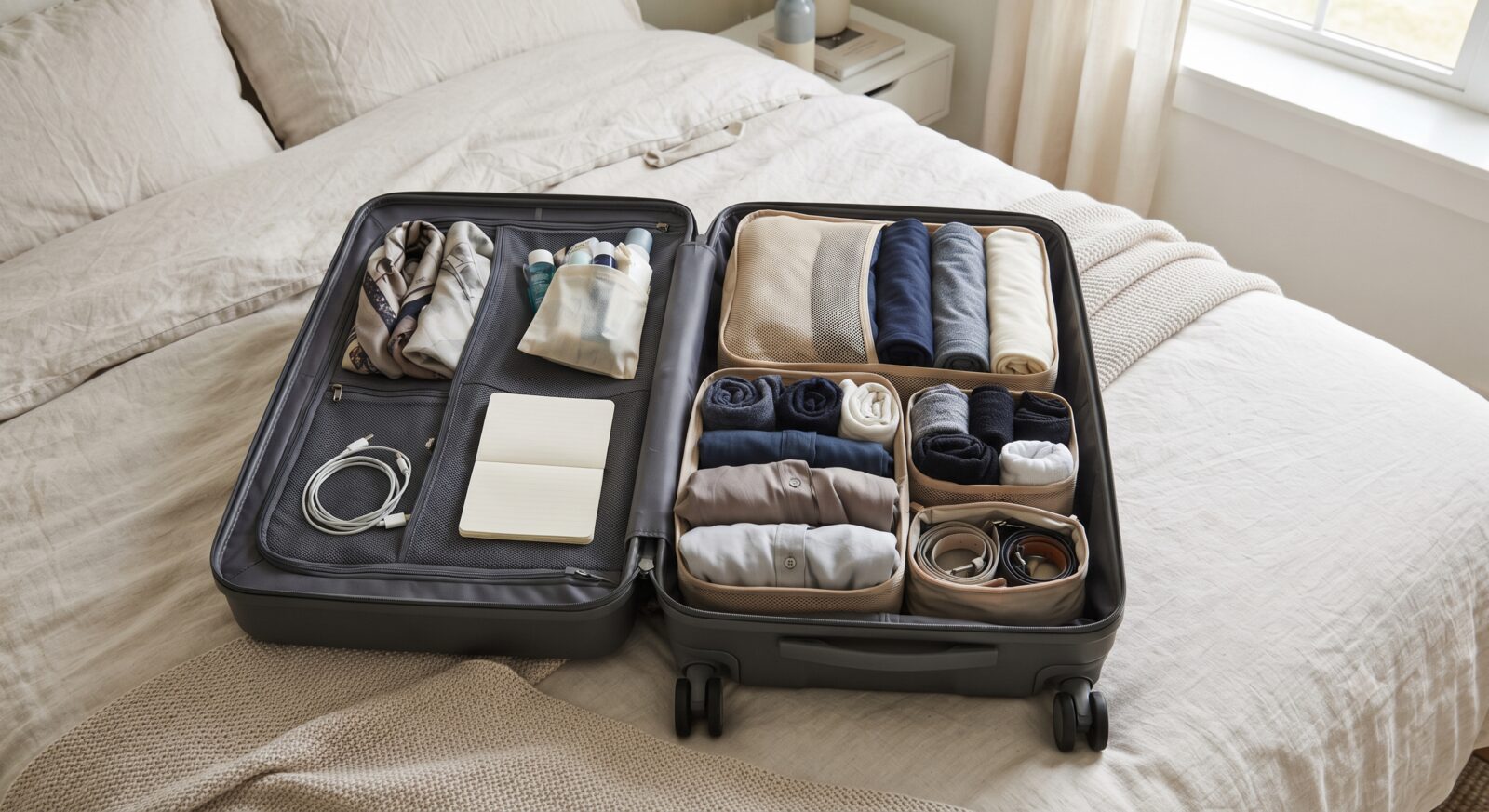
Sorting clothing into packing cubes — by type or by outfit — means you’re not unpacking your entire bag to find one item at the bottom, which matters more on a multi-stop trip than it sounds like it would. Compression-style cubes genuinely fit more into the same bag space, which is worth the small upfront cost if you’re traveling with only a carry-on or one mid-size bag for an extended trip.
The Honest 90% Rule
For anything you’re on the fence about, a genuinely useful test: if there isn’t roughly a 90% chance you’ll actually wear or use it, leave it home. This one habit, applied honestly rather than optimistically, cuts more real weight than any packing technique — most overpacking comes from “just in case” items that never actually get used, not from a lack of clever folding.
How do I pack light for a month-long trip without running out of clothes?
Pack for about a week regardless of total trip length, and plan to do laundry along the way — a hotel service, a local laundromat, or hand-washing. This is the core habit that makes extended travel with a small bag actually work.
Does sticking to one color palette actually help with packing light?
Yes, genuinely — clothing within one general color family mixes and matches more freely, which produces more usable outfit combinations from fewer total pieces than a wardrobe with items in many different colors.
Are packing cubes actually worth buying, or just a marketed accessory?
They’re genuinely useful for organization (finding items without unpacking the whole bag) and, with compression styles, for fitting more into the same space — a real, practical benefit for extended or multi-stop trips.